Calisthenics · Updated 2026-09-16
Planche progression: the road from lean to full planche
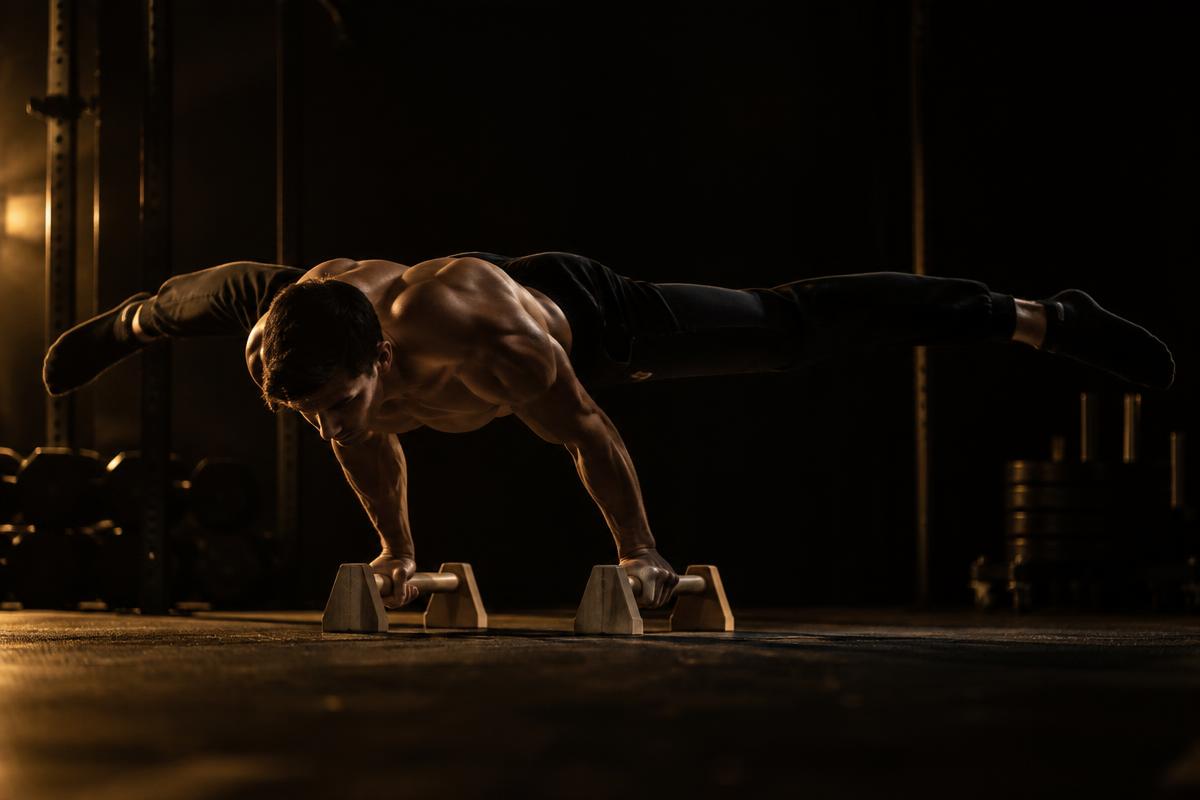
A planche progression moves through five static holds: planche lean, tuck planche, advanced tuck, straddle planche and full planche, each held for 10-20 seconds before advancing. It is primarily a shoulder and wrist strength skill trained with straight arms and forward-leaning shoulders, and it typically takes one to three years of consistent training to reach a full planche.
What the planche actually trains
A planche holds your entire body parallel to the floor, supported only by your hands, with straight arms and no legs touching the ground. The demand is almost entirely on the shoulders, chest and wrists — the shoulders push the body forward and down while the core keeps everything rigid.
This is why the planche is slow to build compared with pulling skills like the muscle up: shoulder tendons adapt more slowly than muscle, and wrist mobility is often the limiting factor before strength even becomes one.
The five-step progression
| Step | Position | Target hold | Focus |
|---|---|---|---|
| 1 | Planche lean | 20-30 sec | Wrist strength, forward shoulder lean |
| 2 | Tuck planche | 15-20 sec | First full weight transfer to the hands |
| 3 | Advanced tuck | 12-18 sec | Extending the lever with hips still tucked |
| 4 | Straddle planche | 8-12 sec | Most of full-planche strength, shorter lever |
| 5 | Full planche | 5-10 sec | Legs together and straight, full lever length |
Wrist prep is not optional
Every planche step loads the wrists in extension under bodyweight. Skipping wrist preparation is the single most common reason people stop progressing — not because they are not strong enough, but because their wrists hurt too much to train.
- 01Wrist circles and gentle stretching before every session
- 02Planche lean holds on the floor to build tolerance gradually
- 03Parallettes or push-up bars to keep the wrist in a more neutral angle
- 04Stop the session if you feel sharp pain, not just fatigue
How to train each step
Train planche work early in the session, three to four sets per position, holding to a slight shoulder cave or hip sag as the sign to stop the rep, not full failure. Two to three sessions per week is enough given how demanding the tendons find this work.
When to advance
Move to the next step once you can hold the current position for 15-20 seconds across three sets with straight arms and no hip sag. Advancing early is extremely common and it is why so many people spend years stuck in a bent-arm, sagging straddle instead of a clean one.
How Calisthenics.dk supports the process
The Skill Tree in Calisthenics.dk lays out the exact planche prerequisites in order, and the Movement Analyzer checks your hold — arm straightness, body line, hold duration — through the camera, entirely on-device, so you get objective feedback instead of guessing whether that straddle was clean enough to progress from.
How the app helps you with this
Frequently asked questions
How long does a full planche take?
Most athletes need one to three years of consistent training. It depends heavily on starting shoulder and wrist strength, and rushing steps almost always makes it take longer, not shorter.
Do I need parallettes for the planche?
They help by reducing wrist strain and giving more clearance for the legs, but the full progression can also be trained on the floor.
Is planche strength useful outside of the trick itself?
Yes. It builds exceptional shoulder, chest and core strength that carries directly into push-ups, dips and handstand work.
Why do my wrists hurt more than my shoulders?
Planche positions load the wrist in deep extension under significant weight. Build tolerance gradually with lean holds and consider parallettes to reduce the angle.
Can I train planche and front lever in the same block?
Yes, they complement each other well — planche pushes, front lever pulls — but keep total weekly skill volume manageable so tendons can recover.
Keep reading
Want the plan adapted to you?
Calisthenics.dk rebuilds the programme around your level, counts your reps through the camera and corrects your form as you go — all on your own phone.